The Dark Knight Trilogy
A review? An homage? Maybe I just need heroes to be cool again

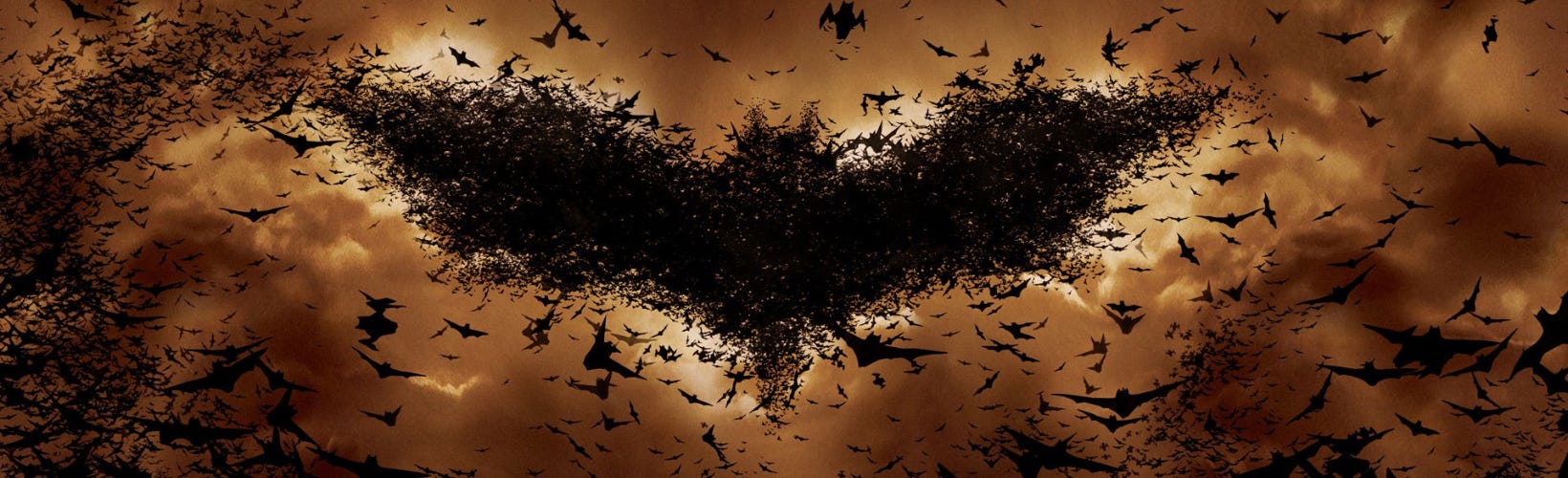
While I wait to begin my new job, I’ve spent my time registering for classes, going to the gym, and revisiting some of my favorite movies and shows. Lord of the Rings always makes the cut, The Sopranos, Alien, IT, and True Detective too. But this past weekend I needed something closer to home, so I put on Batman Begins and by the end, I was wondering what Hollywood has done to our heroes over the last 18 years.
I’m not crazy about pitting comic companies against each other. I appreciate DC and some Marvel and whatever Sony did with Spiderman, so my love for this Batman doesn’t come from loyalty. While not quite in the same epic scope, I would argue Christopher Nolan did for Batman what Peter Jackson did for Lord of the Rings. In both effects and dialogue the movies stand the test of time. Nolan didn’t use excessive CGI and where it’s been used, it works very well, contrasting the slew of Avengers movies that feel almost entirely created in an animation studio. Even the writing still works, remaining relevant and believable after almost two decades, even if a little cheesy at times.
Christopher Nolan does what few directors can with comic books, steering the Dark Knight Trilogy into believably gritty territory, with a real message and incredible acting, all while maintaining the heart of a classic comic with just a little camp. The casting of the Dark Knight Trilogy is unmatched for a superhero film as well. Not just well-known names, but actors who drank the Kool aid and gave the story their all. Heath Ledger’s Joker is widely acknowledged as the best portrayal in Batman history and while I fully agree, I also think Christian Bale is the superior Batman, by a wide margin. He gives us noble, tortured, brooding, and driven. He sells it with the choking voice of a lifetime smoker and I’m willing to believe it’s enough to hide his identity. Michael Caine, Morgan Freeman, Gary Oldman, even Anne Hathaway in The Dark Knight Rises deliver performances I find difficult to match in subsequent Batman revivals. As supporting characters, they beat the brakes off the glorified cameo films Marvel has been spitting out in unending succession. Although I would have liked to see more development of the relationship between Harvey Dent and Rachel Dawes in The Dark Knight, Aaron Eckhart’s chemistry with Christian Bale more than makes up for it. I want Harvey Dent to win as much as Bruce Wayne does. I even want him to get the girl. And speaking of the girl, Maggie Gyllenhal made a better Rachel and should have been cast for Batman Begins. She came into her role with worldliness and grit befitting an underdog ADA in a wildly corrupt justice system.
What really gets me after all these years is the commitment to an honest, empowering message. In each movie Batman must fight a newer, more challenging villain, while weighing his responsibility to Gotham’s regular citizen as a symbol of justice, and the means by which he accomplishes that justice. Like many of our superheroes Batman hides his identity. He does so first to protect his image as Bruce Wayne but chooses to continue in anonymity to embody a symbol rather than a suit. Christopher Nolan chooses not to hammer us over the head with this concept and instead wraps up the trilogy quite nicely with it in The Dark Kight Rises.
The movie is 14 years old; do we really need a spoiler warning?
At the end of an intense chase through Gotham’s streets, Batman, Catwoman, and Commissioner Gordon have run out of options for disarming the fusion reactor with only minutes until it explodes. In this moment, Bruce Wayne sacrifices himself, although his company, and the audience, thinks it is the end of Batman. He attaches a cable to the reactor and says his goodbyes before flying off in his Wayne-ified helicopter, we’ve all been told has a faulty auto-pilot. He flies the reactor far out over the bay but not before saying to Commissioner Gordon, “A hero can be anyone. Even a man doing something as simple and reassuring as putting a coat around a young boy’s shoulders to let him know that the world hadn’t ended”. In this moment Commissioner Gordon understands who Batman has been all along, and we understand Bruce Wayne means what he says.
Batman embodies a degree of integrity that is hard to make fun of, which isn’t to say the parodies in the years since are offensive, they aren’t, but he has serious heart. Batman doesn’t leave room for cynics and nihilists, only action. None of us are likely to be in a position to sacrifice ourselves over a fantastical fusion reactor about to explode over a New York sized city, but we are all likely to be in the position to help someone else, through kindness, effort, and presence.
In the final scenes Detective John (Robin) Blake rappels through a waterfall, discovering the Batcave, and we understand a torch has been passed. I choose to believe Nolan intended, as did the writers of The Book of Revelation, there should be no sequel to this particular rendition. The torch has not been passed just to Robin, but to us. Even though it is revealed that Bruce Wayne survived, we know someone else must put on the cape and answer the signal.
In the face of suffocating corruption, the Waynes used privilege for good and kept a terrorist at bay for decades. When Bruce Wayne’s life removed from the common citizen became an obstacle, he overcame it by placing himself where he could gain the appropriate experience, training, and strength. When someone else was positioned to correct the system, Batman made room, choosing the grueling work of fixing a broken system rather than disregarding it for anarchy. When he could have saved only himself, he chose the community. When he could have abandoned them, he chose hope. And when he could have been the hero, he made sure each of understood it could, and should, be us.